To get the very best out of your infusions, here is a handy 5-point guide you can use to keep your leaves tasting fresh. For instance, black tea stored in the right way will keep well for over two years, so it is definitely worth doing right. All of these points are essentially to stop tea degrading or oxidising – and fortunately it is nice and simple. Scroll on down for our guide:
1. Sunlight
Promise me one thing. Promise that you won’t put your tea leaves into a glass jar and put them on the windowsill. Please, step away from the jam jar. They’ll look lovely, I know, but sunlight is a big offender when it comes to degrading the flavour of tea. Your tea will thank you for it. And so will I. (This is why we will never use packets that have little windows in them. Can’t abide the things).
2. Moisture
When moisture and light combine, the enzymes that kick start the decomposition of tea wake up. So store your tea somewhere dry, away from the oven, sink or dishwasher to keep them at bay.
3. Heat
Find a nice cool spot for your tea leaves in the kitchen or store, and their flavour will be maintained for longer. But please don’t put your tea in the fridge! Moisture and strong smells will wreak havoc on the leaves unless you are very, very, very careful.
Some Japanese green teas can benefit from being stored in the fridge for short amounts of time – keep them well sealed in small packets – but these are the exception.
4. Strong Smells
Tea leaves are very good at soaking up the aromas around them. While this is great for blending, the last thing you want is your Darjeeling tasting like blue cheese or onions. Disaster. So keep your leaves sealed and away from strong smells. (This includes scented teas – keep your single estate and lighter teas separate to your Lapsang Souchong etc).
5. Air
Some aged teas like Pu Erh will benefit from a good air flow, but normally (and to help avoid point 4) it is best to keep your tea in either their re-sealable packets or a closed caddy. Every time you open your tea, the exposure to oxygen will continue the oxidisation process so try to avoid shallow, wide storage tins. Keep as much of the tea’s surface area away from the air as you can.
In summary, keep your tea leaves sealed up somewhere cool, dry, and away from sunlight. A cool cupboard is ideal.
Extra tip: Wood, plastic and clear glass are best avoided as storage materials, but your typical tea caddy, canister or thick lined packet is absolutely fine.
So there you have it – look after your teas with these simple tips, and you can enjoy them for longer.
(and if a friend or family member has tea in a glass jar in broad daylight, bear this cat in mind. I’ll be really proud of you)
The Spring tea harvest season is upon us – one of my favorite times of year in the tea calendar. After laying dormant for the winter (rather like you and I) the tea bushes in Japan are waking up with the change in the seasons, producing their fresh spring growth.
On the 20th of April we’ll be boarding a plane and heading back to Japan once again ready to sample this year’s harvest from Wazuka, one of the original tea growing areas just outside of Kyoto. We’ll also have the opportunity to hand pick and process the tea using centuries-old traditional methods, explore the different varietals grown in the area, and catch up with old friends.
Our Wazuka trip last year
But we’ll be putting together a little extra something for you too. I say little… it is a story that we have been researching for the past few months, and decided that, rather write it as a series of blogs, it would be much, much better as a video. So, as well as fresh tea, we’ll be bringing back with us the story of Sen no Rikyu – arguably the most famous Japanese tea master who ever lived. Some of you may be familiar with his work and the tales that surround his life, or you may never have heard of him! Either way, we’ll be delving underneath the traditional telling of his story to explore the upheaval, paranoia, and charged political landscape of 16th Century Japan, where Rikyu’s Chanoyu (way of tea) was formed and developed.
Tea Master Sen no Rikyu
Our trip will begin with a chance to shake our jet lag in Tokyo before heading to Osaka and Rikyu’s birthplace, Sakai. From there we’ll be heading to Kyoto for two tea ceremonies and a rather special temple visit, before visiting Wazuka. Then we will wave goodbye to Kyoto and spend a night in Kanazawa – a town that played a role in a quite spectacular tea room that we’ll look at in our video – and explore their old streets lined with chayas and samurai residences. Owing to its heritage, Kanazawa has been designated as a UNESCO World Heritage Site, so I am very much looking forward to visiting this beautiful town. After boarding the new Shinkansen line that opened last month, we’ll head back to Tokyo for a few days, before retuning on May 6th. And somewhere in all of this is my 30th birthday…
We’ll be sharing what we find (and eat) on our Facebook, Instagram and Twitter pages, such is the wonder of technology. If you have any recommendations for things to see, eat and explore while we’re there then do let us know! I’m particularly fond of wagashi… (hint hint)
When we were visiting Wazuka the weather was as beautiful and balmy as it is in Dorset right now. Our friend Matsu made us a pot of ice brew Sencha to refresh us in the shade – the method is simple, effective, and delicious. Thank you, Matsu!
Infusing tea leaves in cooler or ice water means fewer tanins (the astringent elements of tea usually released at higher temperatures), catechins and caffeine are released. This chemical difference drops the bitterness and focuses instead on the sweetness of the tea, leaving the bitter compounds behind, and encouraging the refreshing grassy notes of the leaves to shine through.
When you’ve enjoyed your pot of ice brew tea, you can add more ice cubes or cold water and infuse the leaves again. We find that Sencha works particularly well, but you can also try this method with many other kinds of leaf too…
And so from Kagoshima we travel to Kyoto. Another sun drenched ride on the Sakura Shinkansen through the mountainous countryside of southern Japan takes us to the country’s former imperial capital, giving us time to find our hotel and unpack before we head to Wazuka the next day.
We take a sunny early evening stroll around the aquarium and back streets, before ascending through the levels of Kyoto central station to visit a Sukiyaki restaurant, Moritaya, for dinner. The views across the city – and the meal – are breathtaking.
A Misogi hand washing basin in Kyoto
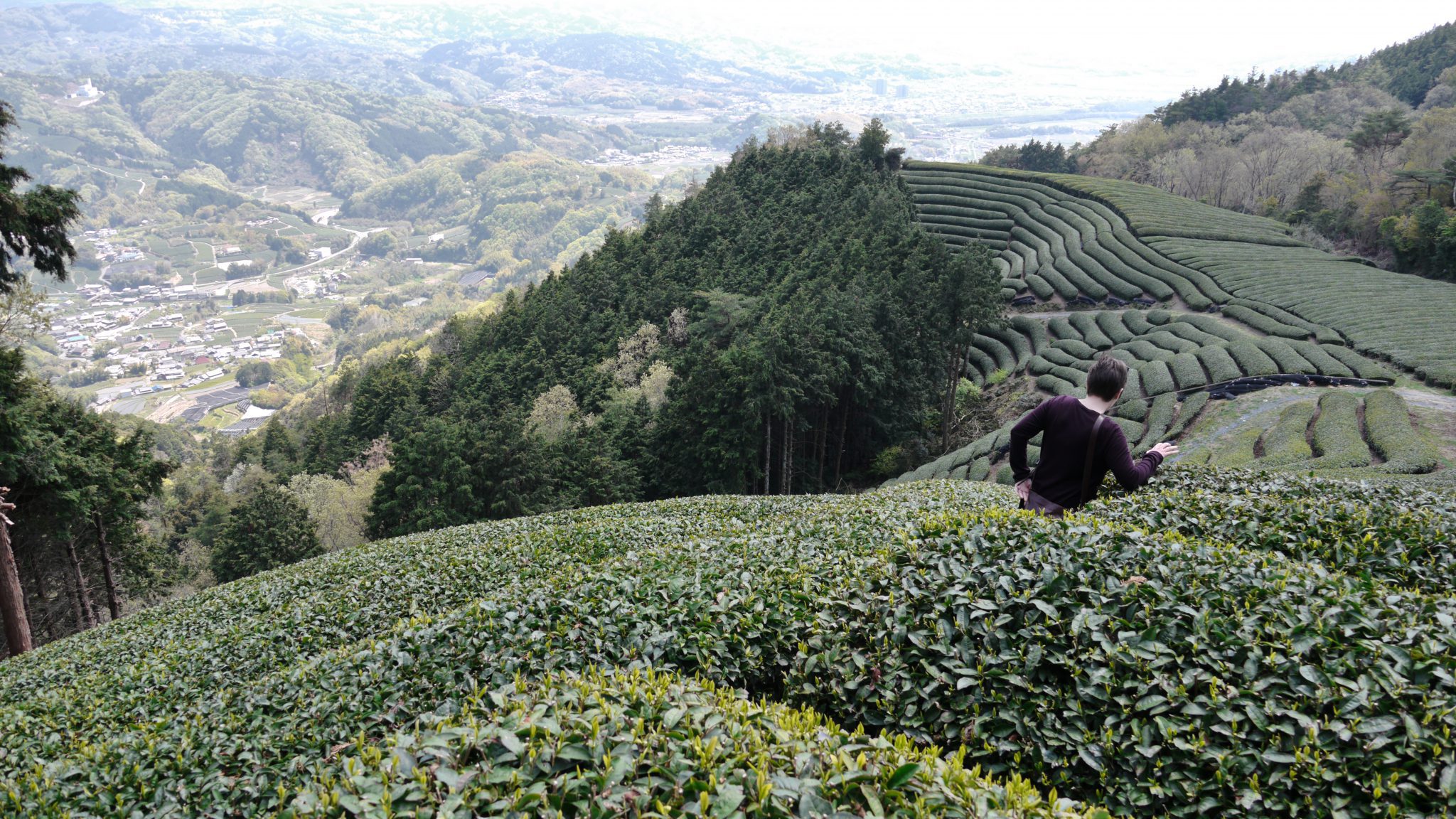
The next morning is another bright, glorious early start – we make our way to the central station to take a mixture of train and bus to the mountain valley town of Wazuka south west of the city. This particular region, including Uji, is Japan’s oldest tea growing region, with a history stretching back hundreds of years to the 13th century. Wazuka sits in a river valley, with mountain ranges arching up to each side – and everywhere you look, even steep, rocky outcrops, are small tea fields hugging the sides of the mountains.
We are here to visit a cooperative of tea growers working together in Wazuka to grow and process their tea without the intervention of larger companies – just like Shigeru and Haruyo in Miyazaki. We take the bus through the valley and walk past the local shrine, surrounded by late season cherry blossoms, to meet our friends Matsu and Simona. The day is warming up quickly, so we share some ice brewed gyokuro tea before heading out to the tea fields.
Miyazaki & Wazuka – tea notes
In Miyazaki in southern Japan the harvest had already begun – but Wazuka’s was still waiting to begin. Being further north, this region’s leaves were a little behind the south. Something else you might notice – the tea bushes at ground level in the Wazuka valley are much brighter in colour than those at higher elevations up the mountainsides. Why is this? The freshly growing leaves take a little longer to mature at higher altitude and will be ready for plucking towards the end of the season, rather than the beginning.
Matsu takes us up the winding mountain roads to over 600m above sea level into the cooler mountain air to one of his highest altitude tea gardens. The forest gently rustles in the breeze as we walk through the rows of tea bushes to taste the freshly growing leaves and admire the view. The mountains stretch mile after mile into the distance, each one home to a small tea field or two as far as the eye can see. Matsu smiles and tells us they call this the heavenly tea field, but when the harvest it, it is hell! The steep slopes call for picking by a hand operated machine, but leaves are not quite ready yet, so for now we will enjoy the view.
We drive back down the mountain past tea fields and wild bamboos as Matsu navigates us down the steep narrow roads – Rob asks is he would have liked to have been a rally driver “Yes!” shouts Matsu. I must admit, he was pretty good round those corners… At the foot of the mountains we explore the lower level tea fields, almost ready for harvesting. Here we see shaded tea bushes, like Shigeru’s, growing tencha for Matcha production, mostly the Yabukita cultivar. Look out for our upcoming post on Japanese tea processing and varieties.
The lower altitude tea fields
We return to their tea house to taste some more of the teas that they produce. Then, Matsu turns around and suddenly puts an old granite Matcha mill on the table – something I had been wanting to see for a very long time! He let us grind our own Matcha on his own mill, making a turn once a second, then drink the freshly ground tea powder. Sweet, vibrant, and grassy, the Matcha is wonderful. We were very taken with their Sencha Genmaicha – a spring Sencha green tea blended with toasted brown rice. Keep an eye out, this year’s fresh harvest will be joining us soon!
We enjoy a late lunch in a little noodle place near the shrine. Sitting out in the sun, we enjoy big bowls of Matcha cha soba and cups of hojicha tea.
Cha Soba Noodle lunch
After a few more pots of tea the afternoon air takes a cooler turn and it is time for us to to travel back to Kyoto. We arrive back in the early evening, and tuck into some Katsu and cold beers for dinner.
We have the whole of the next day to explore Kyoto – the weather is hot and sunny once again, and visiting a tea house for a tea ceremony could not have been better timed. In the centre of the city we find a cool, quiet shaded courtyard with a small tea ceremony house next to a koi pond. The tea master takes us through the steps of the ceremony, and invites us to whisk our own Matcha in the calm, quiet atmosphere. With every touch of her hand on the tea scoop and chasen, it touches you like a gentle hand on your shoulder.
A hidden shrine near the centre of Kyoto
Refreshed, we head to visit a tea shop in an arcade (something our tea shops have in common!) called Horaidos. Run by 4th generation tea masters, the shop sits in an old building that a new arcade has been built around. Everywhere are piles of papers, lists of tea, boxes, and tea caddies stacked all over the back of the shop. Behind a pile of papers and boxes we spot a row of meter-high traditional Japanese tea urns, where the weight of the tea itself inside was the element that kept the tea fresh. I am taken with a Matcha Natsume and pair of drinking cups – we speak with the specialist who explains that the Natsume’s name translates as “Lanterns on Cherry Blossoms at Night”.
The Horaido natsume, its storage box, and drinking cups
As night falls we head into Gion to find somewhere for dinner, and just off one of the main roads we decide on a tempura place. Cold sake, tempura, and green tea – perfect! We take our time walking back across the river, and a side street, Ponto-cho, filled with red lanterns catches our eye. As we head down the alley past bars, rows of lanters and small restaurants, we see a bar window full of jazz covers- on the door it reads “Hello Dolly” a jazz and cocktail bar. How can we resist? Inside is exactly how you would imagine a speakeasy. A long, dark bar lit by tassle-edged lamps with small tables and Art Blakey playing in the background. We’re told a quartet is playing that night, so we order martinis and stick around. We are glad we did – you’ll hear the group playing a great version of “I Remember You” in our video. I fell a little bit in love with the pianist, she was sublime.
A few more cocktails later, we head back to bed.
Tokyo
The end of the trip is just a couple of days away – we hop on the Shinkansen and return to Tokyo central station. We had two days to explore a few things in the city, and the first place we went to was Akihabara – Electric Town. 6 story arcades and huge book, model and game stores line the main street. The next day is bright and warm again, so we spend some time in Yoyogi park where we saw the street performers you’ll see in the video – we loved them – and head into Shibuya, home of the largest pedestrian crossing in the world. The side streets are packed with little restaurants, bars, shops and fast food joints, as well as being home to gigantic department stores. The food level of the department store at Shibuya station is absolutely vast…
Shibuya
The next day is my birthday! Rain clouds begin to sweep over the city, so we decide to take the train over the rainbow bridge to an island in Tokyo bay called Odaiba. The island is essentially a huge leisure park, complete with giant ferris wheel, and is home to the Sega Joypolis – an indoor theme park full of rides, games, a rollercoaster and live action horror mazes. (I back out of the Sadako 3D ride – if you’ve seen Ringu I’m sure you’ll understand why! – but the House of the Dead ride is great. The perfect rainy afternoon!)
View of Tokyo and the Rainbow Bridge from Odaiba
When we’re done with zombies, racing and rides we head back to Ginza and into Hibiya to visit a certain special someone.
Godzilla. A little smaller in real life.
Hibiya is home to Tokyo’s Godzilla statue, marking the spot where this iconic lizard is taken down at the end of the 1954 movie. I also pick up an old (and slightly broken) Godzilla figurine to take home. He now takes pride of place on my desk next to my tea caddies and books. The last restaurant we visit is a lovely Sukiyaki and Shabu Shabu place in Ginza, where we try our hand at cooking snow crab and enjoy some melt-in-the-mouth sashimi. We finish our cups of sake, and head back to the hotel ready for an early start back to the airport the next day.
And on the plane we start planning a return trip…
Make yourself a cup of tea and take a look at the video of our trip – and subscribe to our new channel!
 Menu
Menu
 Shop Bag